Project Synergy
Project Synergy is a £5 million Innovate UK-funded project. The aim of this project is to further develop innovative technologies for connected autonomous vehicles to accelerate adoption of driverless vehicles and allied technologies in the UK.
This project will introduce innovative technologies to operate connected autonomous cars in a platoon formation from Stockport directly to the arrivals terminal at Manchester Airport. Concurrently, a platoon of three pods will transit passengers to and from a car park in the airport to the passenger terminals.
Project Synergy will facilitate inclusive accessible transport for the aged and the visually impaired. Innovations include:
Aims & Objectives
The aim of this project is to further develop innovative technologies for connected autonomous vehicles to accelerate adoption of driverless vehicles and allied technologies in the UK.
- To expand the platooning concept through concept transfer from ecological, social and biological perspectives.
- To undertake popular and expert discourse analysis to understand the landscape of AV integration on public roads in the UK.
- To develop a digital simulation model testing the integration and disruptions resulting from the introduction of AV into a competitive environment with other forms of transport services and passengers
- To examine advantageous routes for the deployment of AV through data mapping.
Updates
+ Research: Discourse Analysis
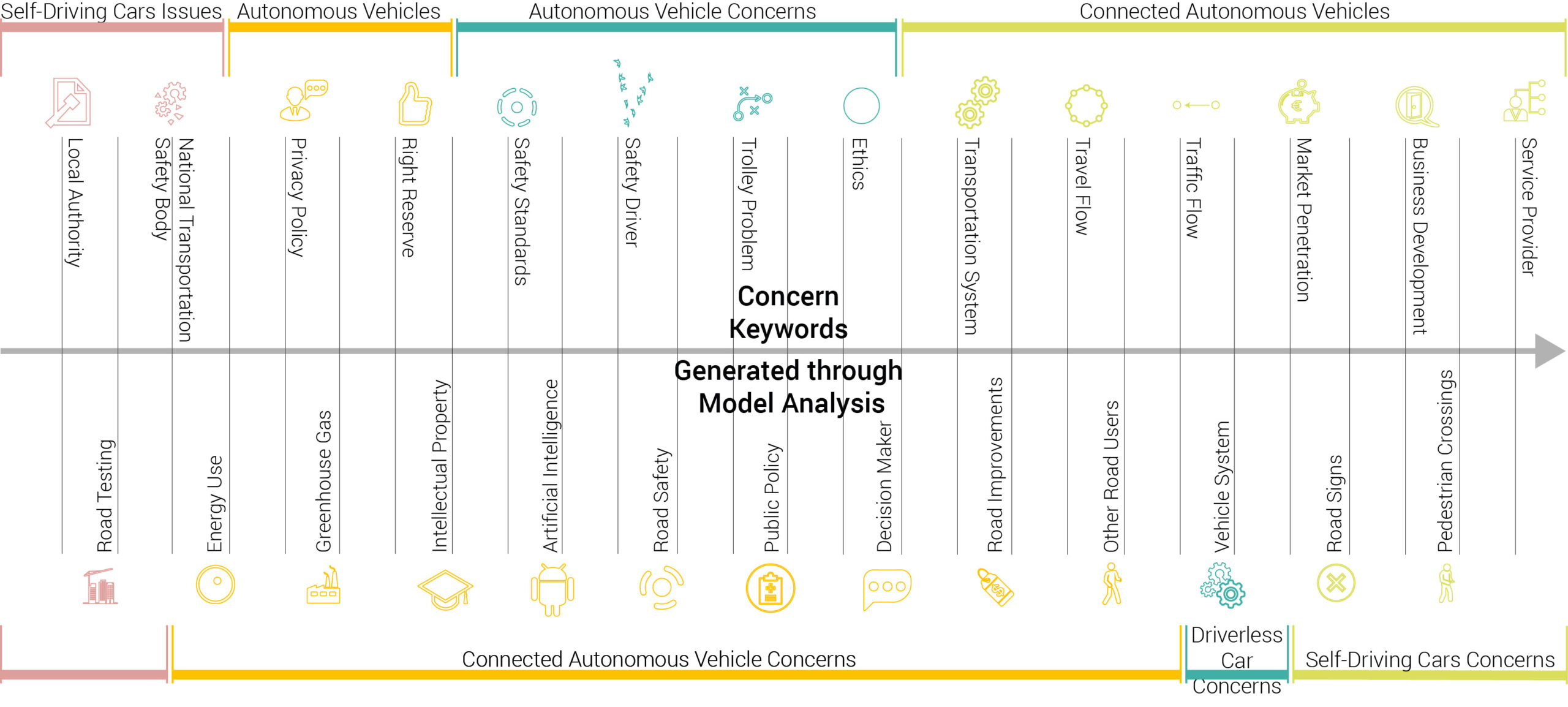
Using specific terms as search criteria on the web, a collection of 682 sources was analysed to distil a number of specific words relating to concerns surrounding the implementation of CAVs on public roads.
From this analysis, 10 concerns have been identified as the dominants in the written discourse. These concerns are as follows:
Access the methodology review here.
Occupancy and Emissions Sustainability Metric Matrix
These concerns have been reinforced as well as debated using real-world interviews with specific groups as well as results from workshops conducted in an international conference. The result of this study identifies the concerns found in the discourse as valid when going forward with a CAV dominated future mobility system. At the same time, not enough mention on the transition of the technology exists within the discourse with concerns focused on the end result rather than the journey.
+ Platooning Concept Transfer
The word platoon has its origins in the French word peloton, which refers to a group of cyclists, particularly the main mass of cyclists riding in some kind of formation in the race. Platoon in the army refers to a principal subdivision of a military unit.
The benefits of increased efficiency, minimising human errors and safety advantages are some of the main drivers for implementing this technology for various vehicles (such as drones, army vehicles, public and private transport). Insects, birds and fish display collective behaviour that is based on each member’s localised knowledge and interaction with its neighbours.
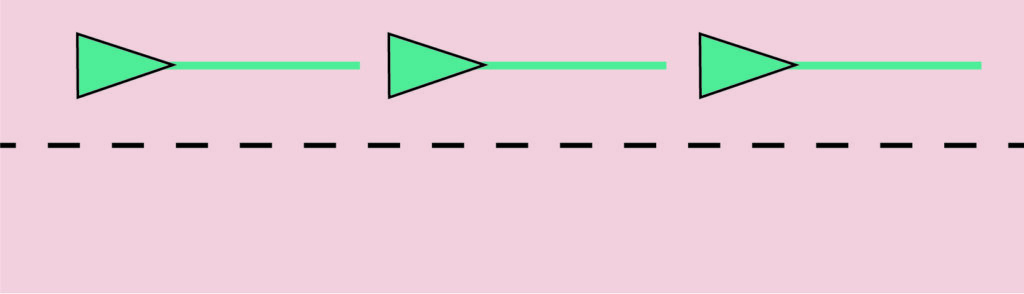
The aim of this report is to expand the platooning concept. At the moment, platooning of CAVs is understood as a formation of vehicles where there is one lead vehicle and following vehicles that communicate with each other. This allows the vehicles to move more efficiently (reducing drag and having less unnecessary accelerating and braking compared to human drivers) and safely, as it eliminates human error, which is the main cause of traffic accidents.
In this report, we will look into the origins of platooning as a term in order to understand the origins of the concept. Then we will look into natural and human-made formations and methods that display similar characteristics to platooning and how they have been applied in other areas.
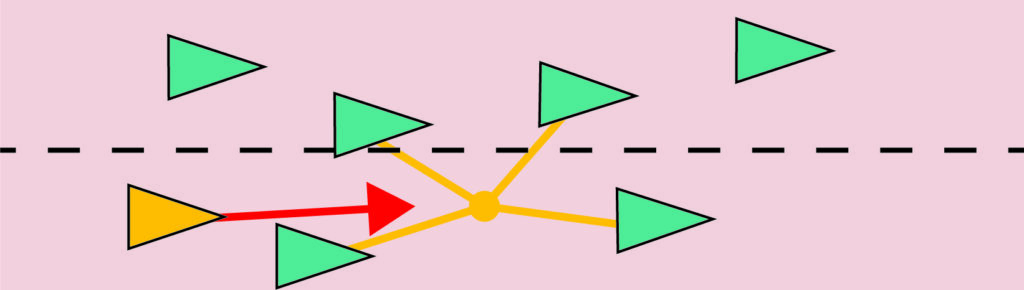
At the end, we will provide our observations and comments on how the platooning concept for CAVs could potentially be expanded further. Herds of animals, fish schools, and flocks of birds are characterised by an aggregate motion, main characteristics of which are:
Ordered
Chaotic
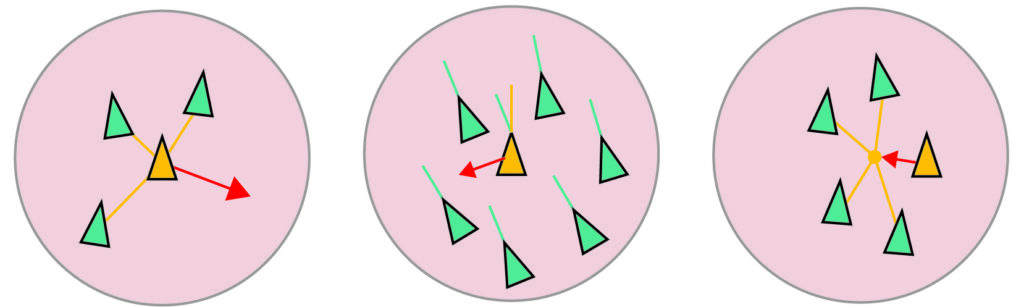
Platooning Concept Diagram
Flocking and Swarming are behaviour models that have been studied and applied to crowd modelling, computerised problem solving, AI, swarm robots and unmanned vehicles.
Our research so far into platooning in nature does not indicate a need for a conventional leader. Although the idea of a lead car is in some ways warranted in an autonomous vehicle system, must that leader be predefined? The question arises as exploration into natural systems has shown leadership in a flock of birds or ant/bee movement being shared among all members of the group.
We offer behaviour patterns as an alternative to the existing leader-following structure of platooning CAVs.
Access the full report here.
+ Autonomous Vehicles Concerns: Content Analysis of Public Sources
This report aims to understand the concerns surrounding the implementation of Connected Autonomous Vehicles on public roads.
Access the full report here.
+ Urban Simulation: Resource Competition and Service Performance
The main aim of this work is to define and better understand the benefits and spatially advantageous patterns of using AV to
explore the deployment of Connected and Autonomous Vehicles (CAV) in Greater Manchester.
Access the full report here.
People
Principal Investigator: Ulysses Sengupta
Co-Investigators: Rob Hyde
Researchers: Solon Solomou, Sigita Zigure
Funding: Innovate UK (£5 million)
Publications
Sengupta, U. (2018). Smart Cities: CityVerve and greener mobility strategies [Lecture]. Lecture to the Nomura Foundation and Japan Development Bank, Manchester City Council, Manchester, United Kingdom.
Sengupta, U. (2019). CityVerve: Greener transport planning with IoT [Invited lecture]. Tokyo Institute of Technology, Tokyo University, Japan.